
An experiment on Digital Negatives with MakeQuad
MakeQuad (MQ) has a Digital Negative mode. This mode is still experimental, because I don't current have my own lab for testing. But I participated in a workshop on Platinum printing at G99 given by Constanza Isaza from Lux Darkroom during which I had the chance to make some tests.
The idea behind the Digital Negative mode of MQ is to base the calibration entirely on the contact-printed positive (nobel print) and to try to obtain the correct transparency film negative by inkjet printing without the need to measure the UV density of ink patches on the transparency film. Here I use my P900 with OEM inks, Pictorico film and Hahnemühle Platinum Rag.
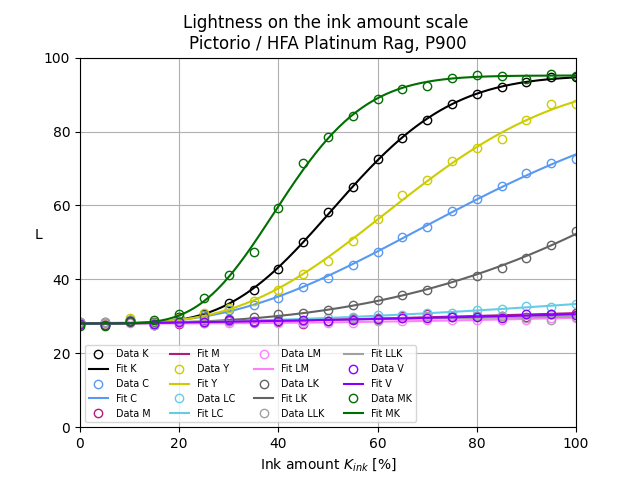
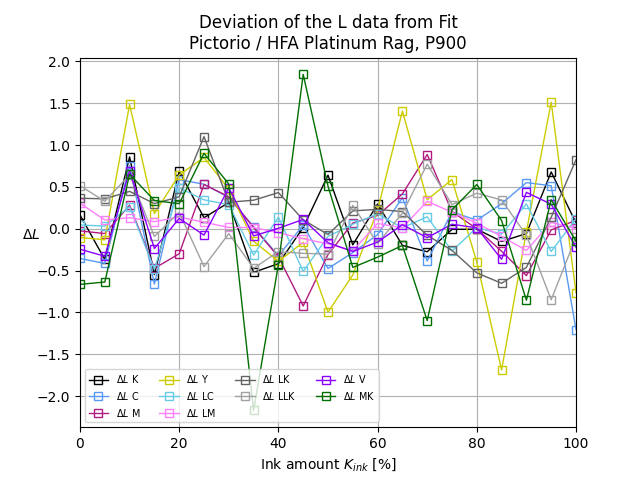
After printing the ink separation on Pictorico film (ink limit 100%) using MQprint (or QTR), making a Platinum print and measuring the Lab data of all patches, the *.dat files were prepared which MQ expects as the raw data. The calibration in MQ yields the curves shown in fig. 1a. Figure 1b shows the deviations of the measurements from the fit functions.
|
|
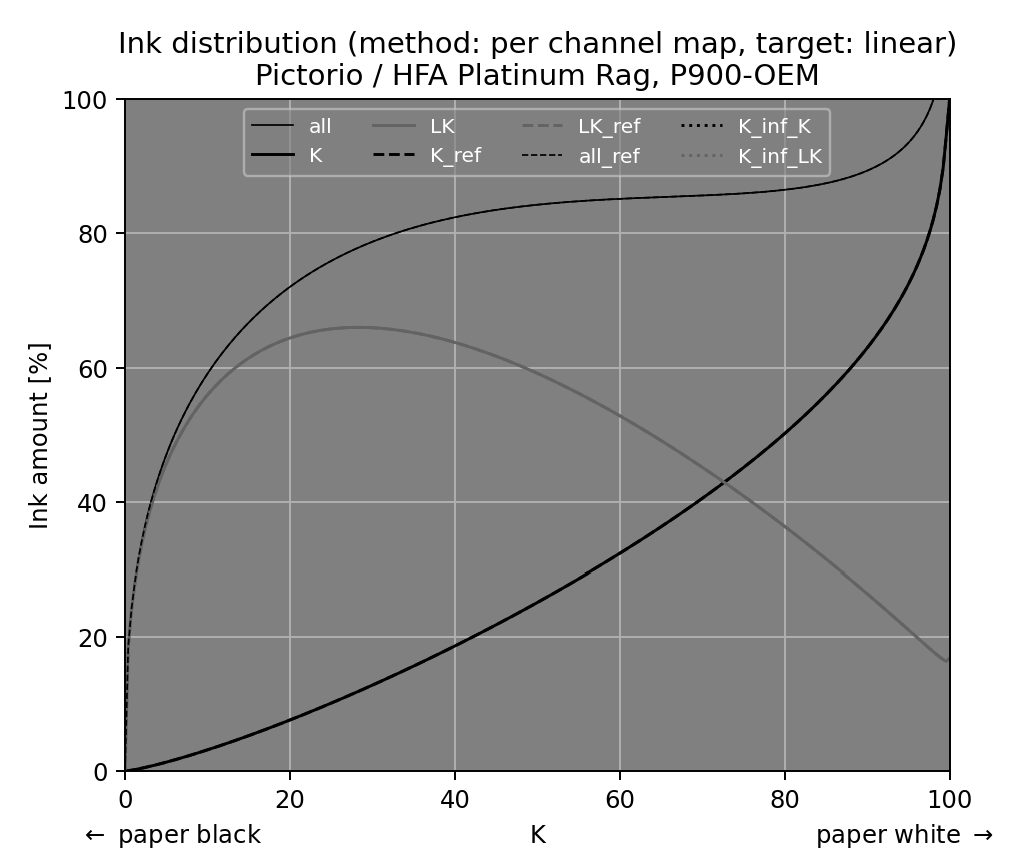
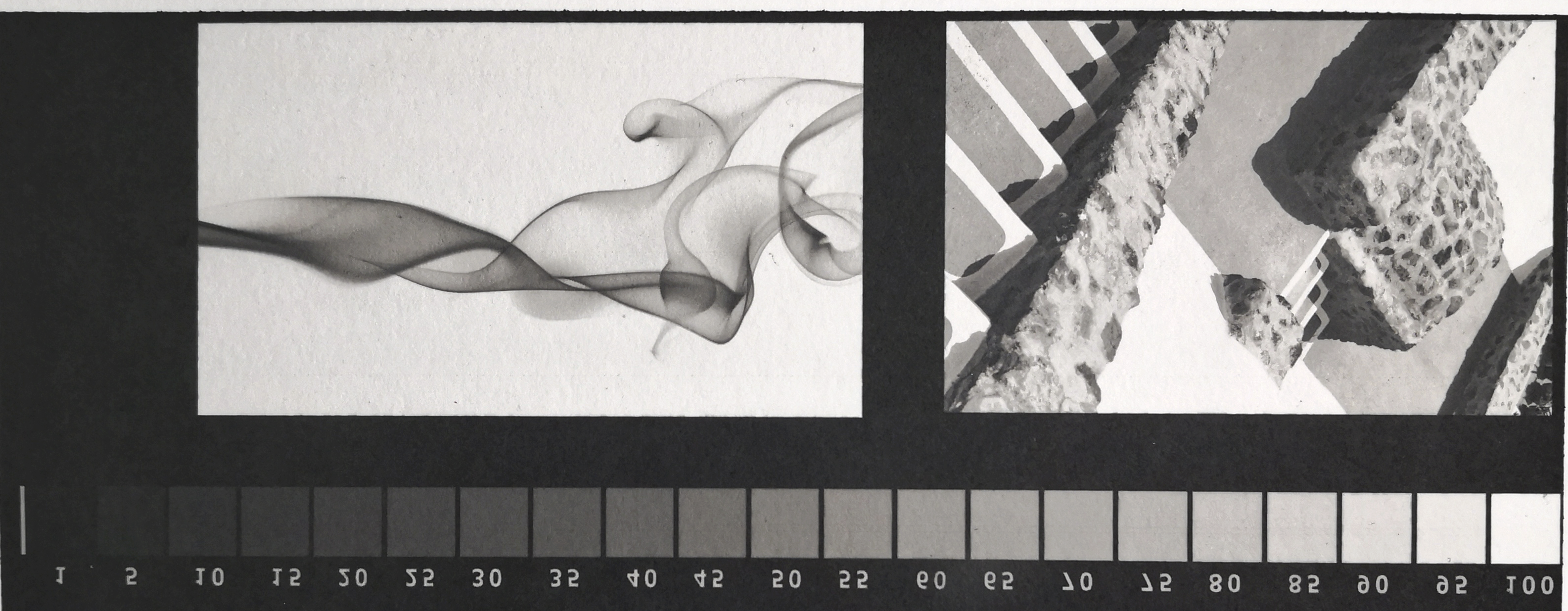
The MK channel is not used for the negative, because the matte pigment creates a grainy tone. To avoid the pure color inks Y and C which have properties different from the carbon inks K, LK and LLK, I considered only these latter inks. LC, LM, LLK and V had to be excluded, because they do not print dense enough on the negative. Using the method 'per channel map' (PCM) of MQ, I decided on the ink distribution shown in fig. 2a, targeting a linear lightness in print. After creating a quad file from this ink distribution, a 21-step wedge together with two sample negatives is printed on Pictorico film and a Platinum print was made. The print is shown in fig. 3. The step wedge and the sample images look quite acceptable.
|
|
Discussion
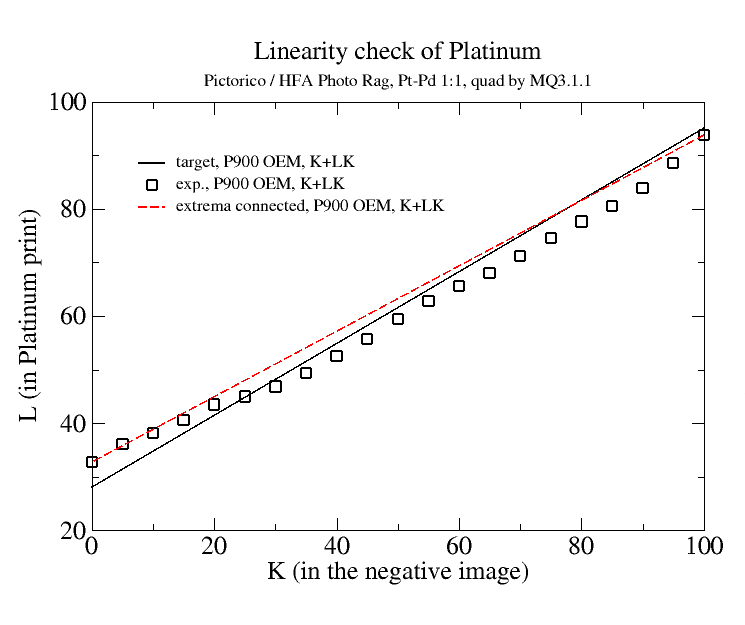
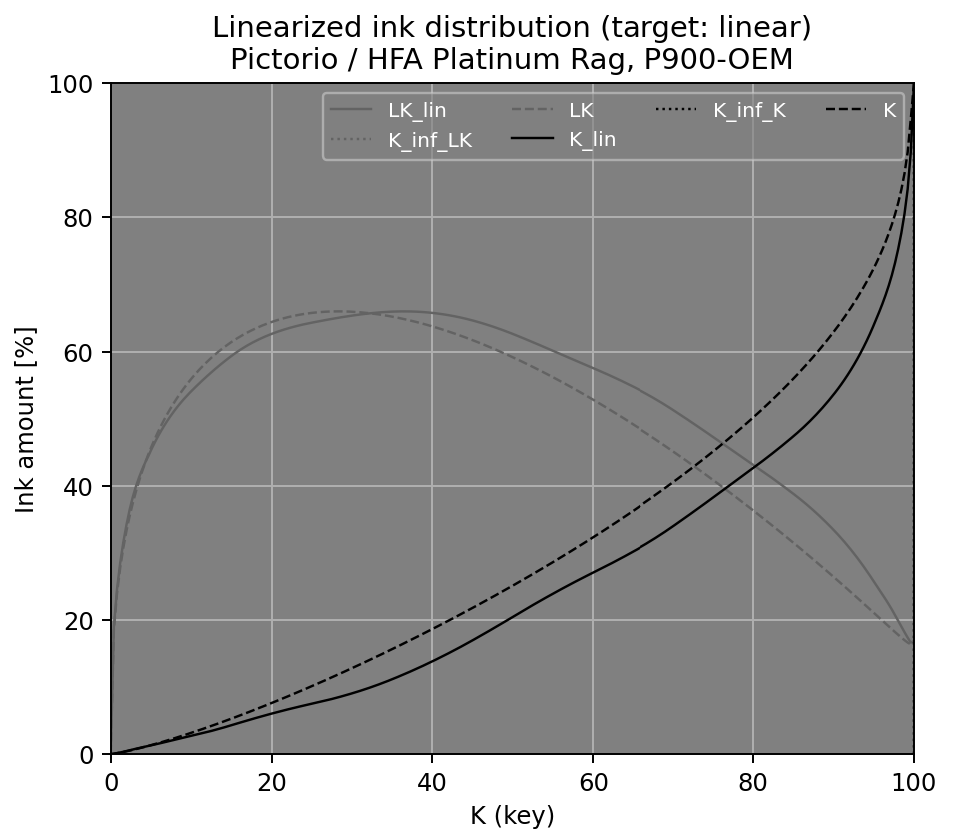
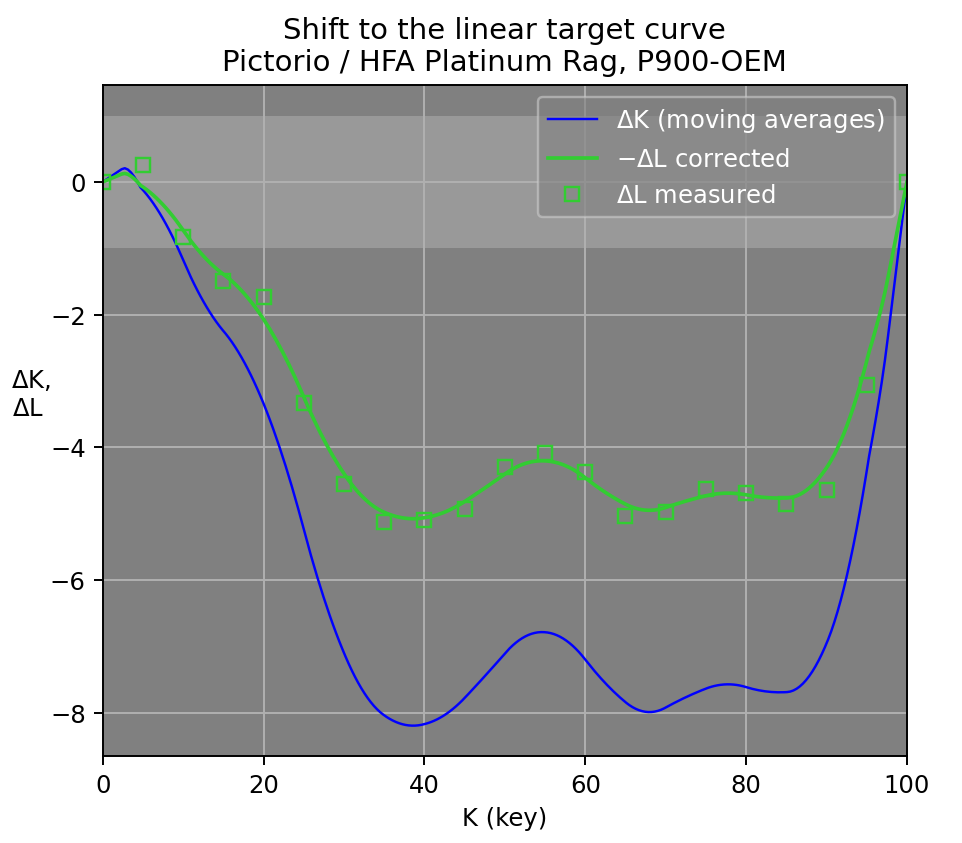
Measuring the step wedge reveals that there are deviations from the linear target lightness (black line in fig. 2b). In particular, the clear film (at K=0) printed significantly lighter than the target. This could be due to an emulsion variation or a different humidity of the paper when being exposed. The white point at K=100 is slightly lower than the target value. Based on the linear lightness curve defined by the actual black and white points measured (red dashes in fig. 2b), the midtones are still somewhat too dark. This can be remedied by linearizing the ink distribution in MQ based on the measurement and activating the option 'Update b/w Points'. Figure 4a shows the ink distribution before (dashed lines) and after linearization (solid lines). The associated K shift is displayed in fig. 4b. Unfortunately, I had no opportunity to make a Platinum print using the linearized quad file.
|
|
The experiment has shown that it is possible to arrive at reasonable quad files for alternative processes using MakeQuad. However, the promise of an automatic linearization with the methods 'auto' and 'per channel map', which safely holds true for the positive process, may not always be guaranteed for Digital Negatives. The reason is partly related to the difficulty to establish a robust and accurately reproducible chemical process (emulsion, development). Nevertheless, the quad files resulting from these methods can serve as good starter curves which can be linearized with MQ in a second step, provided the lightness L is a monotonic function of the key K.
If the negative is only printed with a single channel any deviations from the target lightness is almost certainly due to a variation of the chemical process. In order to be able to use a single channel only this channel should have the potential to reach the saturation lightness (L_max) in print, equivalent to the blocking density in the negative. As can be seen from fig. 2a, this may not fully be the case here for the K channel. But in view of the long foot of the curve, the exposure could have been increased somewhat upon which the curves for K would have shifted to the left.
August 2026